Research
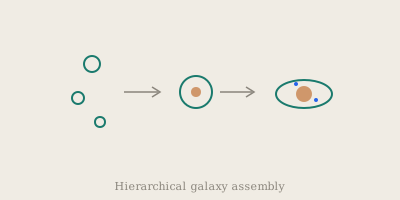
Near-Field Cosmology
Using nearby dwarf galaxies as laboratories to understand galaxy formation and stellar populations. Multi-wavelength observations with the Hubble and James Webb Space Telescopes reveal the detailed structure and star formation histories of local Universe galaxies, informing our knowledge of early cosmic structure.
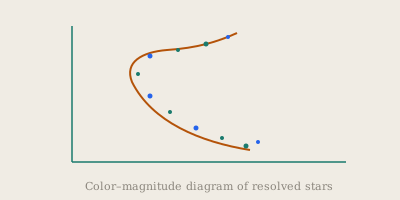
Stellar Archaeology
Analyzing stellar populations and individual star properties to reconstruct the formation and evolution history of galaxies. By studying resolved stars in nearby galaxies, we can determine ages, metallicities, and dynamics that reveal how galaxies assembled over cosmic time.
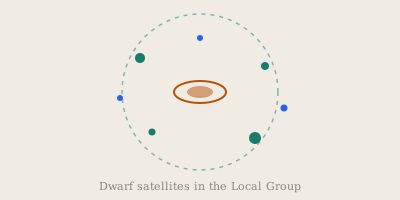
Galaxy Formation and Evolution
Understanding how stars and galaxies form, evolve, and interact over cosmic time. Our research connects observations of the local Universe with the early Universe, bridging the gap between nearby galaxies and the first galaxies that formed after the Big Bang.
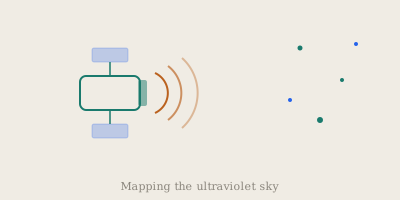
UVEX: Ultraviolet Explorer
Lead scientist for UVEX, a next-generation NASA mission that will survey the entire sky at ultraviolet wavelengths. Launching in 2030, this mission will revolutionize our understanding of star formation, stellar evolution, and galaxy evolution across the Universe.
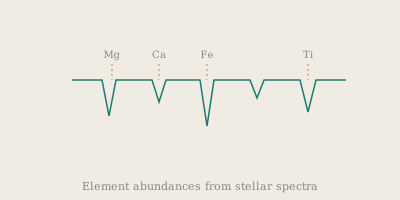
Chemical Abundances
Measuring the detailed chemical compositions of individual stars through resolved-star spectroscopy with Keck, JWST, and Subaru/PFS. Element-by-element abundances—iron, alpha elements, and neutron-capture species—record the enrichment history of a galaxy, tracing how successive generations of stars forged and dispersed the elements across cosmic time and revealing the baryon cycle in low-mass galaxies.
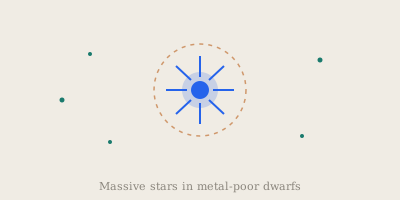
Low-Metallicity Massive Stars
Studying the most massive, luminous stars in nearby metal-poor dwarf galaxies, where conditions resemble those of the early Universe. Their intense ultraviolet radiation and powerful stellar winds drive the chemical and energetic feedback that shapes galaxies; surveys with HST, JWST, and UVEX probe how massive-star evolution and feedback change at the low metallicities characteristic of the first galaxies.